The Fire-Thermomechanical Interface (FTMI) is our proprietary model designed to perform advanced, performance-based analyses of structures exposed to realistic fire conditions. It achieves this by creating a highly precise, one-way coupling between a gas-phase fire simulation (CFD, using Fire Dynamics Simulator) and a solid-phase structural analysis (Finite Element Method, or FEM).
⚡ The Challenge in Fire-Structure Coupling
Advanced CFD models are excellent at simulating the 3D evolution of a fire, capturing complex gas temperatures, velocities, and incident heat fluxes. However, these fluid models cannot accurately evaluate temperature distributions and thermo-mechanical responses within solid structural elements.
Furthermore, CFD and FEM models utilize fundamentally different discretization methods — meaning the size and shape of their computational meshes rarely match — making direct data transfer incredibly complex.
FDS2FTMI: Bridging Fire Dynamics and Structural Analysis
FDS2FTMI is an automated tool designed to establish a one-way coupling interface between the Fire Dynamics Simulator (FDS) and Finite Element Method (FEM) codes.
By leveraging the Adiabatic Surface Temperature concept alongside convective heat transfer coefficients, FDS2FTMI accurately recreates the net heat flux from a fire simulation into a thermomechanical environment. Recently updated to support complex structural designs, the tool extracts boundary data from both traditional rectilinear FDS blocks and unstructured, triangulated geometries.
Automated Interface
Streamlines the translation of FDS thermal outputs into FEM boundary conditions.
Complex Geometry Support
Reads both standard boundary files and unstructured geometry files to map data onto arbitrarily complex shapes.
Independent Modeling
Decouples fire and structural domains, allowing multiple structural optimizations against a single fire scenario.
Broad Compatibility
Directly outputs formats for ANSYS and a streamlined CSV-based FTMI format, with support for other major FEM solvers.
📘 For installation instructions, formatting guidelines, and detailed verification cases, please refer to the FDS2FTMI User Guide on Google Drive →
How the FTMI Process Works
To seamlessly bridge this gap without losing precision, the FTMI methodology relies on the concept of Adiabatic Surface Temperature (AST) combined with the convective heat transfer coefficient.
Keypoint Tracing
The code traces the exposed surfaces of the FEM structural model and generates a collection of "I keypoints" located at the precise center of each external face, capturing their normal directions.
Data Mapping
The code then searches the fire simulation output and maps the corresponding AST and film coefficient variables directly onto these specific keypoints.
Complex Geometries
For structures with complex, sloped, or oblique geometries, the FTMI process utilizes vector composition to project the AST and film coefficients onto the normal direction, accurately accounting for the true 3D orientation of the physical surface.
Structural Evaluation
These mapped thermal boundary conditions are applied to surface effect elements on the FEM structural mesh. This establishes an iterative solution that calculates total heat flux to predict true deformations, stresses, and strains.
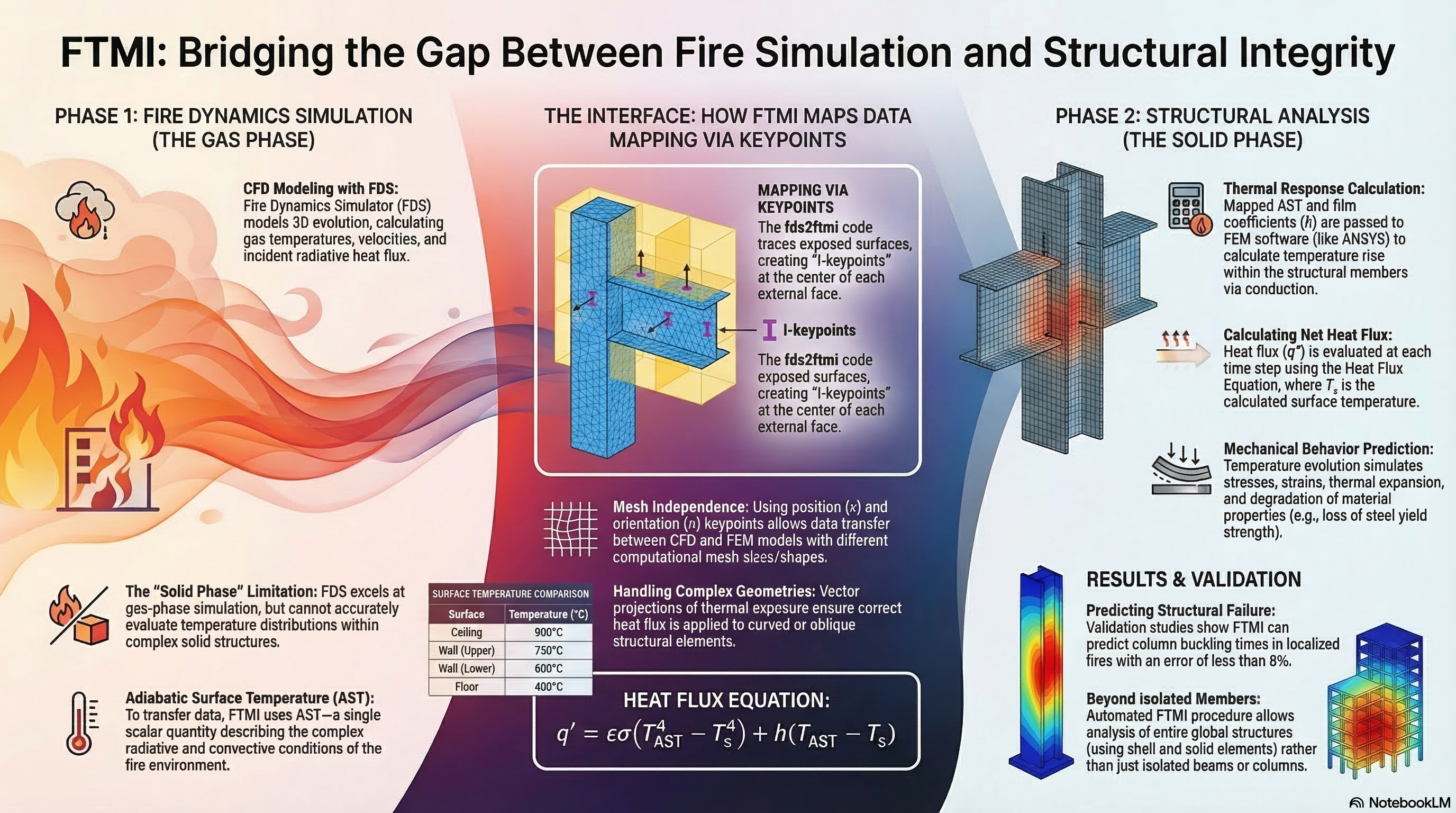
FTMI Workflow and Data Mapping Procedure
The Business Value of FTMI
⚡ Computational Efficiency
Because data is mapped from the fire simulation directly onto independent structural keypoints, small structural modifications or member resizing do not require the computationally expensive CFD fire simulation to be completely restarted.
🌍 Global Evaluation
FTMI moves structural fire engineering beyond the outdated, prescriptive analysis of isolated structural members in standard furnaces. By fully coupling CFD and FEM, RIO on Fire can accurately evaluate the global behavior of your entire structure under highly realistic, localized fire scenarios.
Applied FTMI: Architectural Freedom & Complex Environments
Explore how the FTMI methodology translates into actionable engineering solutions.