Fire Simulation (CFD)
We utilize the Fire Dynamics Simulator (FDS) to accurately model chaotic fire growth, heat release rates (HRR), and complex thermal gradients. We map precise 3D fuel distributions to understand exactly how a localized threat behaves within your unique geometry.
Structural Analysis (FEM)
Using advanced Finite Element Method (FEM) solvers, we predict global structural behavior under extreme thermal stress. We capture large displacements, material plasticity, and critical load-shifting phenomena like catenary and tensile membrane actions.
Proven Capability: Engineered Case Studies
Our methodologies have been validated across extreme environments and highly complex commercial architectures.
Nuclear Containment & Extreme Environments
The Challenge: Evaluating the survivability of cylindrical steel containment vessels under severe, localized thermal threats (e.g., 100L hydraulic fluid fires).
The RIO on Fire Solution: By deploying our integrated CFD-FEM method, we modeled the exact asymmetrical buckling and thermal bowing caused by severe internal stress. We predicted the final buckling time with an error margin of less than 10% compared to physical tests, proving the vessel's survival beyond prescriptive expectations.
Offshore & Heavy Industrial Assets
The Challenge: Oil rigs and ethanol yards represent billions in capital and face complex, chaotic pool fires that standard ISO 834 curves cannot replicate.
The RIO on Fire Solution: We replaced uniform heating assumptions with realistic 3D fuel distribution models. This allowed us to map exact localized thermal gradients and engineer localized protections, saving millions in unnecessary global application while mitigating true risk.
Commercial High-Rise: Composite Floor Systems
The Challenge: Reducing the immense cost and weight of passive fireproofing on multi-story commercial steel-concrete composite floors.
The RIO on Fire Solution: We modeled the global interconnected system rather than isolated beams. By accurately simulating Tensile Membrane Action, we proved the floor system's inherent ability to redistribute loads under high temperatures, allowing for a strategic reduction in applied fireproofing while guaranteeing compliance and safety.
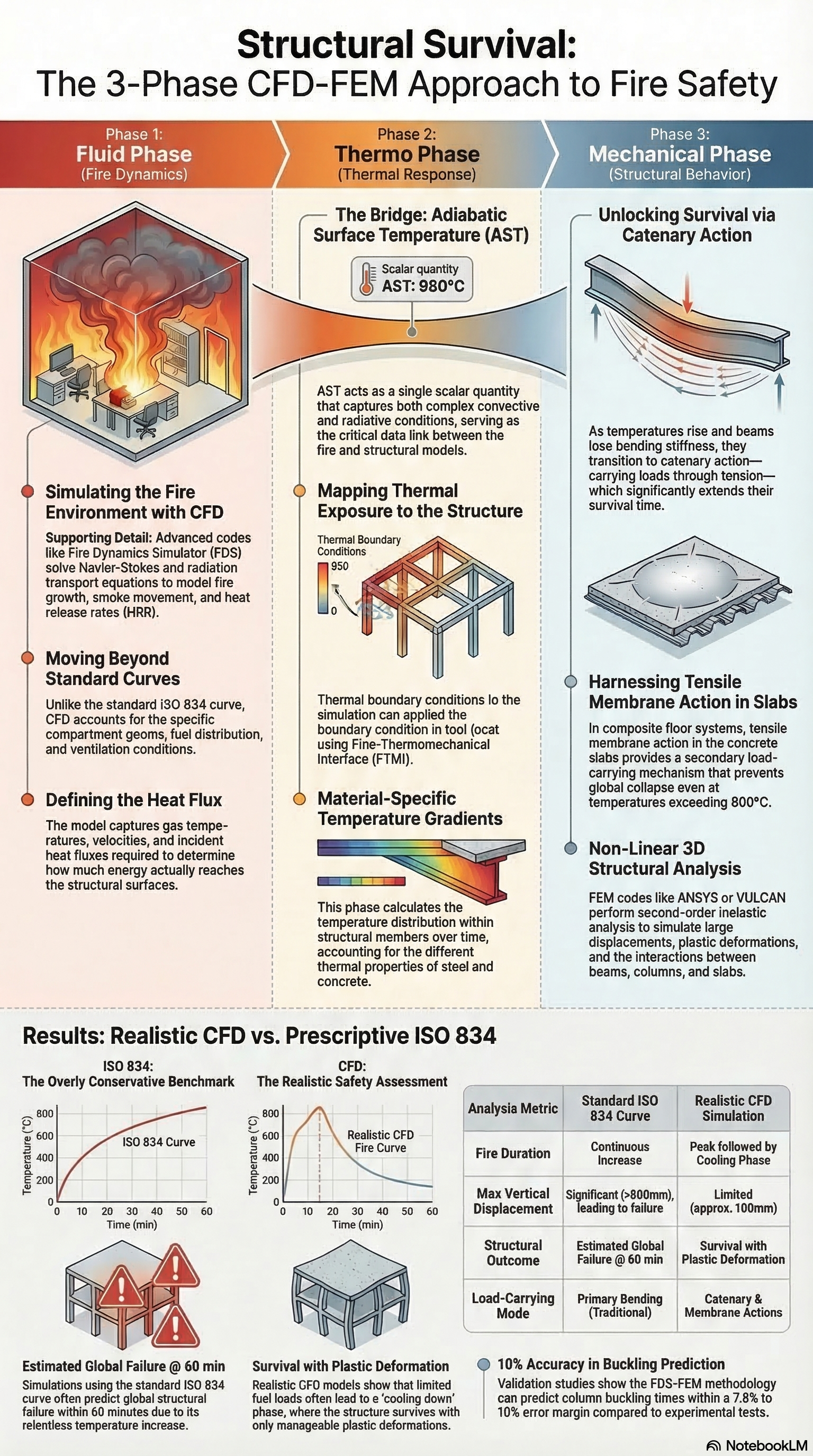
Composite floor system under fire loading — tensile membrane action simulation